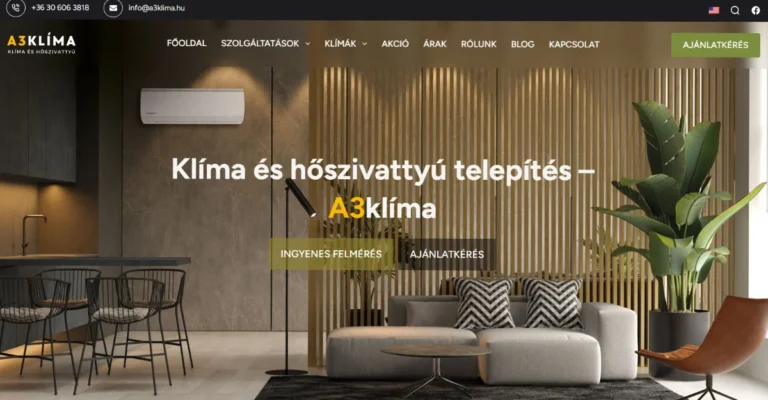
Most WordPress theme showcases focus on portfolios, shops or agencies. Local trade businesses are one of the most common real-world use cases, and one of the most overlooked. Electricians, HVAC technicians and installers need a site that does one job well: turn a visitor with a specific problem into a quote request.
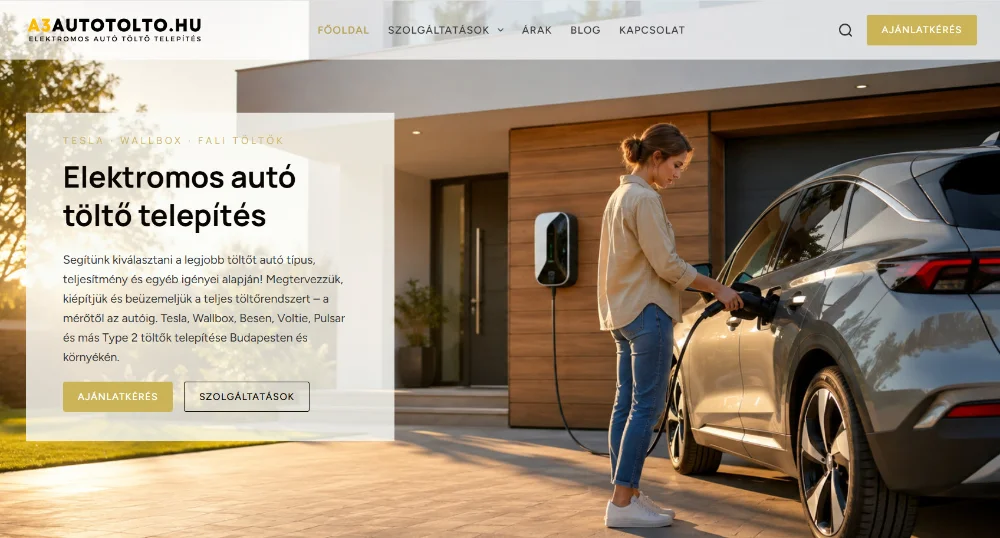
This case study walks through a recent project, A3 Autó Töltő, an EV charger installation service in Budapest. It covers how the site was structured and why each section is there.
The client and the brief
The client is an established HVAC and electrical contractor expanding into electric vehicle charger installation. They are a certified Tesla installer, but they also fit Wallbox and other Type 2 chargers. Alongside charger installation they offer general electrical work and air conditioning installation and maintenance.
The brief had three priorities:
- Make EV charger installation the clear headline service, with electrical work and air conditioning as supporting services.
- Answer the questions people ask before they pick up the phone, especially about price.
- Make the quote request reachable from anywhere on the page.
From static mockup to WordPress
The homepage started as a single-file HTML mockup. This let us agree on content, section order and visual hierarchy before touching any theme settings. Once the client approved the layout, it was rebuilt in WordPress so they can edit content, add blog posts and extend service pages themselves.
For service businesses, we recommend this workflow. Clients react much better to a concrete page than to wireframes. It also prevents the classic trap of bending the content to fit a theme demo.
Page structure: every section has a job
Hero with brand strip. The hero says what the business does, where it works (Budapest and the surrounding area), and which chargers it installs. Below it, a row of car manufacturer logos tells visitors immediately that the service is not limited to one brand. That matters because many EV owners assume a Tesla installer only works with Tesla.
Three service cards. EV charger installation, electrical work and air conditioning. The electrical card explains why it belongs on an EV site: charger installs often need meter upgrades, new circuits or a new distribution board, and offering this “from one hand” is a real selling point.
Target groups. Separate blocks for detached houses, condominiums and companies. Each group has a different decision process. A condo installation involves the residents’ association and the utility provider, while a company needs multiple charge points and load management. Addressing them separately lets each visitor recognise their own situation.
A niche-specific section: company cars. In Hungary, employees who charge a company car at home can claim the cost if the consumption is measured with a MID-certified meter. This is a high-intent audience with a clear problem, so it got its own section instead of being buried in a list.
Explaining price instead of hiding it. Charger installation prices vary a lot, and “from X” pricing rarely holds up. Rather than leaving price out, the site explains what drives it: cable cross-section, RCD protection, surge protection, distribution board capacity, and surface versus flush mounting. It also states the fixed fee for the on-site survey. This filters out unrealistic expectations and builds trust before the first call.
Four-step process. Survey, written quote, installation, handover. A simple numbered process reduces uncertainty, which is often the real reason people don’t request a quote.
Gallery, FAQ and contact form. Real installation photos, a short FAQ (duration, permits, brands, survey cost, warranty), and a contact form with a service dropdown, so incoming requests arrive already sorted.
Technical notes
- Performance: the site is cached with WP Rocket, which is a reasonable default for brochure-type sites with image-heavy sections.
- Consent management: cookie consent is handled with granular categories (statistics, personalisation, marketing), so analytics and ads only load with permission.
- SEO groundwork: each service has its own page instead of only living on the homepage. Content targets the questions people actually search for, and a blog is in place for supporting articles.
- Persistent CTA: the “Request a quote” button sits in the header and in a sticky mobile bar, so it is always one tap away.
Takeaways for trade business websites
- Lead with the service people search for, not the company’s history.
- Show which brands or products you work with. Visitors often filter by this first.
- Split content by audience when decision processes differ.
- If you can’t publish fixed prices, explain what the price depends on.
- Put local, regulation-specific information on the page, such as metering and tax rules. It is useful to visitors and hard for competitors to copy.
You can see the finished site at a3autotolto.hu. The site is in Hungarian, but the structure works for any local service business, whatever theme you build it on.